Honor System
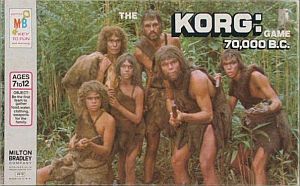
KORG: 70,000 B.C.
FOR 2 TO 4 PLAYERS
| A game based on the new T.V. show depicting the life and hazards of primitive man. Teams gather the things they need to exist, and they hunt for these things in pairs. They need Water, Food, Clothing and Weapons to protect themselves and use in the hunt. They rush around and if one source is dried up, they hurry to another source.
|
TO SET UP THE GAME:
- Place game board on the table.
- Each player chooses (2) two pawns of the same color, that become a team.
- Card are mixed and each player is dealt one card - the remainder of cards are dealt face down into the 4 corner areas marked for cards. There are 4 basic types of cards Food, Water, Clothing and Weapons. There are 6 "Ambush" cards and 2 "No Value" cards.
OBJECT:
Be the first team to gather the 4 Basic Cards: "Food," "Water," "Clothing," and "Weapons."
TO PLAY:
All players roll 1 die. High roll will go first — others follow clockwise in turn.
- Player going first will throw 2 dice and must move each of his 2 pawn team by the count of the dice. One pawn on the count of one die, the otter pawn on the count of the other die.
EXAMPLE: (A six and two are thrown. One pawn must move 6, the other 2).
- Each player must move his team end will usually try to keep them as close together as possible, unless they are blocked and cannot move.
IMPORTANT: A player must move his team in a clockwise direction on the board. They may take the side tracks off the inner track, still moving in a clockwise direction.
One team member can be on the inner track, while the other is on the outer track to rejoin again. They can rejoin the inner track anywhere on the board where the path leads but cannot reverse their movements.
- When one member of the team lands on a card space by exact count, he may draw a card from that area. When another member of a team lands on the same space as his partner by exact count after both have moved their count, they may take a card from the nearest card area. When players land on "card" space at the same time, they get "1" card only.
If all cards are gone from one area, a player cannot take from another area. He has lost that card, and that area is considered dry.
- When another player lands on the same spot as another (single) pawn by exact count, he may draw a card from that player's hand. If the player so caught has an "Ambush" card, he may play that card at this time, and draw a card from the challenger, instead of giving up one of his own, Once an "Ambush" card is played, it is out of the game and cannot be used again in this game.
A player on a safe spot cannot be challenged.
- Both members of a team on the same spot cannot be challenged and are safe, other players cannot pass them or land on the same spot. Any two players on the same space cannot be passed or landed on.
A player coming from behind them on the path must take the full count of the dice or lose his move if his way is blocked.
- A player may wait in a "safe" area and will place his piece off the track at that spot so others may pass. He will roll only one die in that position, that count given to the man on the path. He may "hide" in this position as many tins as he likes, and other players may use that "safe" area at the same time.
- When the safe player decides to return to the path, he again rolls 2 dice. He cannot change is mind once he throws the dice. When a player has given up a card, he knows who has that card. That card, just lost to an opponent, could be of "No Value" or the "Ambush" card as well as a needed one. In future turns the team may hopefully be able to get the card back again. The constant exchanging of cards
could make this difficult.
Players may chase each other on the board to get the cards they need, but a player cannot be challenged if he is in a safe situation or place. The hunt can move quickly from a dry area {no cards) to a more fertile area, always in the same direction.
- The first player's team to have the 4 needed cards. shows the cards and wins the game. He may also have other cards of no value or extra needed cards in his hand at this time.
© 1974 By Milton Bradley Co. under Berne & Universal Copyright Conventions Made in U.S.A.
4519
